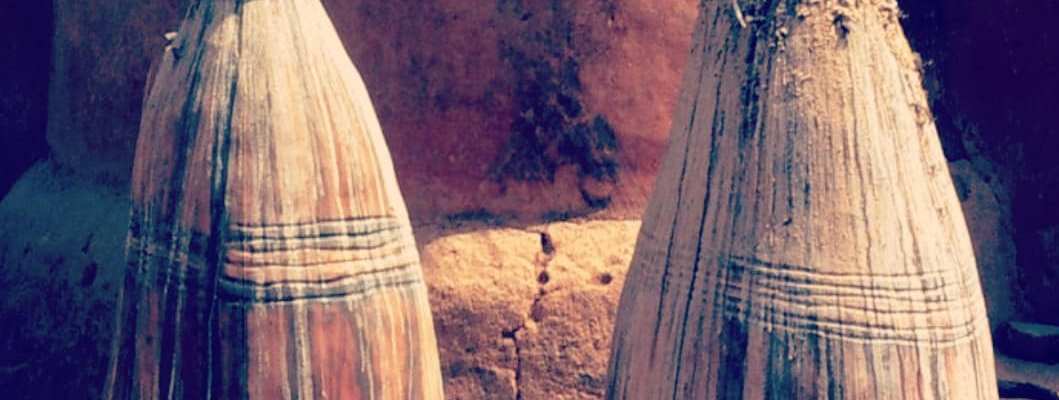
Among the Frafras, the boundary between the living and the dead is not a wall but a thin veil. Ancestors are not buried and forgotten; they are consulted, invoked, and honoured. They are not dead to us. They are closer to the Source.
To the Frafra mind, God is supreme, but the ancestors are trusted intercessors, those who lived well, served their families, upheld justice, and died peacefully and elevated. They stand between the living and God, just as prophets, saints, and martyrs do in other religions. When libation is poured, it is not to the ancestor as a god, but to God through the ancestor. As we say: “To’e zom ta paa Nayine.” To wit, take this flour-water to God. We do not worship them; we commune with them and through them. Just as Christians pray through Jesus, and Muslims invoke prophets and angels, the Frafra invoke their ancestors, not because they are divine, but because they are family and have never failed when called upon. One does not go to strangers when one’s father is at home.
Not just any elder becomes an intercessor. Only those who lived truthfully, who died in peace, not by violence or disgrace, are venerated. These spirits protect, intercede, and punish when the living stray from what is right. That is why if you swear falsely by your ancestors, calamity follows. They are not evil spirits. As the elders say, evil gods are often imported, not born of our land. Our ancestors detest evil. Their role is to safeguard the lineage, not to haunt it. There was a video of the former president of Ghana, Jerry John Rawlings, telling a story. Two men were in court. The judge asked them to swear on the Bible. One agreed. But the other refused and said, “No. Let us go back to our village and swear by the shrine. Not by the Bible or the Qur’an.” When asked why, the man explained, “Because if we go to the shrine, he will tell the truth. But if you let him swear on the Bible or Qur’an, he will lie and feel nothing.” That story tells us something we don’t want to admit. People are not afraid of the Bible. They are not afraid of the Qur’an. They swear on it and lie boldly. But take them back to their village, to the ground where their ancestors are buried, to the shrine that carries their name, and they will tremble. Because there, truth is not a performance. It is a consequence. Our people know what happens when you lie to your ancestors. It is spiritual accountability, rooted in culture, tied to land, and reinforced by generations of experience. It means the blood remembers.
In honouring them, we honour ourselves. The living, too, are future ancestors. How we speak of our dead determines how we will be spoken of. This is not fear, it is continuity. It is how the Frafra has always understood existence: you are never alone, because your ancestor’s blood flows through you. You are not separate from them. You’re a copy of them, ancient genes lucky enough to see existence through new eyes. Old genes repeating themselves, still reaching, still remembering. Biologically, you’re them. Spiritually, they’re you. We were never without gods. They did not wear robes or ride on clouds, but they walked with us, and we called them by name. Look how far we have drifted. Today, many Frafras kneel before the God of Abraham, forgetting the Gods of Yaab Zambok, Yaaba Abaa Bagre, Yaaba Adimasuuya, Yaaba Ania Belekuure, Yaaba Apobaga and Yaaba Atamne, among many others. We look to distant lands for salvation, while our ancestors are left thirsty in the dust. We honour Jesus, but not our grandfathers. We quote the Qur’an, but not the wisdom of the ancestors.
The truth is that every religion is a form of ancestral worship. I can already hear people scoffing: “What can your dead ancestors do for you?” But ask yourself this: Is Jesus alive? If he is, show me. Is Mohammed alive? If so, then show me. Weren’t they once humans? Don’t they have a lineage? And where exactly are you located in that lineage? You worship someone else’s ancestor and question your own. That’s not faith, that’s confusion. One common argument is that Christianity and Islam brought schools, and through those schools, many of us received an education. That is true. That is fine. But that does not mean we cannot question them. That does not mean that, if we dig deeper, we won’t find contradictions, manipulations, or outright cultural annihilations. Questioning is not disrespect. Truth should not be afraid of examination. This is not a call for you to stop being Christian or Muslim. But however bitter the truth may be, it must be said and said loudly.
Because Christianity, from its very first encounter with our continent, labelled our ways satanic, our drums demonic, our shrines evil, our ancestors forgotten. If they dared to demonise us, we must have the courage to interrogate them. If that makes me “intolerant,” so be it. Truth is not always polite. Sometimes it must shout where it was once silenced.
If you worship the God of Abraham as a Frafra, or as any African, for that matter, you are lost. That is not your ancestor’s God. Not your covenant. It is not your voice in the shrine. You are worshipping the gods of another man’s bloodline. Wearing his cloak, reciting his history, mimicking his prayers. You are not original. You are an imitator. The worst part is you’ve forgotten who you were before you put the cross on. But the earth still remembers your footsteps. The shrine still knows your name, and the ancestors are still waiting.
We will remain disconnected until we return to our own, until we pour libation not just with Pito but with remembrance. Our children will inherit our confusion and continue to kneel before the gods of other men’s fathers and pray in languages that do not know our names. So, we change our names, hoping those gods will hear, but we cannot change our blood, and we cannot change our roots. We think we have found the way to God, but we are lost, confused, standing at the crossroads, shallow where we should be rooted, echoing words that carry no memory of us. We are like a heedless sheep, wandering deeper into confusion, grazing on the pastures of other men’s truths, while our own truths rot behind us, unburied, and we call it progress.
Written by Dr. S. Atalebe
 My Bolga Online
Great piece 👏 truth should not be afraid of examination
LikeLike