
Written by Stephen Atalebe
Sambo Adabire, the legendary Frafra musical icon, has been considered by many to be comparable to Bob Marley in how his music has dominated the Frafra music scene even after many years since his death. The contribution that Sambo made to Frafra music is comparable to what Bob Marley did to reggae music, redefining the kologo music in his unique style of play as well as the powerful social messages and witty sayings that he has left behind, paving the way for many others to rise to the challenge and take the kologo music to the next level. Before his death in July 2014, Sambo had clinched a deal with Chop Time Music through King Ayisoba to record his songs, but death blew everything away. Sambo Adabire comes from Zaare, Aburiya’s house.
Sambo started playing the kologo at nine while in school, but as more people began to listen to him, he eventually abandoned school and started playing at pito bases, funerals, weddings and other social functions. Sambo drew the crowd to him; the crowd loved and paid him. He began making his tunes and being inspired by kologo musicians such as Franko, Anu’isi Dongo, and Adimazanga. Through Morgan Avalum’s efforts, Sambo recorded his first album at Berekum, near Sunyani, in 2000, and Ayuune Sule showed him where to make his label. His first album was a hit which propelled him forward to the top of Frafra recording artists. Sambo went on to release over fifteen albums.
Sambo’s songs are born out of lived realities, using his experience and thoughts about life to embody powerful messages relatable to most people. For instance, in one of his songs, he asks, “Hu enge ze’ele ge ki yo?” to wit; did you build the house before death? In the song, Sambo says that he told his father to build a house, but his father was afraid to do it because he would die if he did.
“I told my father to build a house because if he gives birth to a charlatan tomorrow, the charlatan will not be able to sell the house; he will sell only his room. My father told me that if he built a house with blocks, the ancestors would kill him. My father is dead today, even though he did not build it. Because of that, poverty continues to grow in the family.”
In the past, there was a particular misconception that if you built a house with blocks, you would die, and this misconception made many people not build their homes with cement blocks but mud. It is this mindset that Sambo wanted to highlight. As with every illusion, the evidence refutes the claim; many people have built and lived in their houses for many years. The deeper meaning of the song underscores the consequences of inaction. Whether you do it or not, you will die. Sometimes, we are afraid to take action because of some imagined effects. Sambo encourages people to be courageous and not be like his father, who, despite not building the house, still dies, resulting in poverty for the family.
The experiences of poverty leave a lasting impression on children from such families, and Sambo’s songs spoke to the hearts of the many young people hustling daily to make ends meet. Sambo carries a powerful message to the youth in one of his hit songs, Nera Woo Pedi. Sambo sings,
“Everyone should hustle to survive. Ayariga Bagna Bia nera woo pedi. My mother insults me that I’ve achieved nothing, and by now, someone insults my father that he is no one. Baba, the gossip is too much; everyone should hide their anger, fight poverty, and hustle to survive.”
In Nera Woo Pedi, Sambo encourages the youth to engage in valuable ventures to fight poverty and stop saying, “This person did this, or that person did that,” which can be distracting. Sambo teaches hard work and determination to overcome poverty and survive by all fair means. Sambo recognised the need for children coming out of poverty-stricken homes to know they can escape poverty through hard work, determination, and resilience. Using his experiences as an example, someone from a poor family made it into the best-selling Frafra kologo musician and was invited to perform nationwide.

The essence of Sambo’s life message extends far beyond the boundaries of the Gurune-speaking people. The notes interwoven into his songs hold a universal significance, resonating with viewpoints that have echoed through the words of philosophers across centuries. In one of his acclaimed songs, Tara ka namesi ho kanbange hu neriba, Sambo underscores the notion that wealthy individual who hasn’t faced poverty may never truly comprehend the authenticity of their friendships.
“Because of my money, I have people. If I don’t have money, I don’t have people; Abagna Naba had money; he had people; when he had nothing, he had no one. Because of my money, I have brothers; if I don’t, I have no brother; if I have no money, my friends become my enemies, and my enemies become my friends.”
Sambo says that riches attract people of all sorts. Yet, devoid of wealth, those connections may dissolve. Just as Abagna Naba’s wealth once drew people to him, his destitute state left him isolated. The song eloquently states that money shapes relationships; in its absence, friendships can turn adversarial, and foes can become allies. Sambo’s lyrics cast light on the intricate and, at times, opportunistic complexities of human behaviour. Money draws people closer, but when the wealth diminishes, so does their presence. This transformative nature of associations based on monetary conditions echoes a universal truth. Sambo’s messages convey a universal language akin to the musings of Aristotle, who discerned different types of friendships based on utility or pleasure. Similarly, Karl Marx’s convictions regarding the influence of material possessions and societal divisions on human connections resonate in Sambo’s observations.
Sambo’s messages were diverse, covering everything that helps people navigate in society. His songs touch on humility with a grounded perspective. In one of his hit songs, Tera ndaami la, Sambo advises people not to forget their past if they have achieved some level of success.
“Remember the past. Who is this person who laughs at others because they are not successful? Don’t you remember how you suffered to be in this position? Think about your past and remember that poverty is in front coming, poverty is behind waiting for you, and joy comes in the middle; remember your past.”
Sambo advises against mocking or laughing at others who are not successful. The German term Schadenfreude describes people who derive pleasure from others’ misfortunes and encourages compassion and empathy. Sambo is, therefore, advising the successful ones to avoid Schadenfreude. Sambo’s lyrics highlight the importance of acknowledging and not forgetting the struggles and challenges one has faced to reach the current position. Sambo’s verses also emphasise the transient nature of success and the importance of staying humble and grateful even in times of prosperity because “poverty is in front coming, poverty is behind waiting for you, and joy comes in the middle”. In effect, Sambo’s songs teach the importance of considering one’s past struggles and successes, treating others with kindness, and maintaining a balanced perspective on life’s ups and downs. Sambo encourages individuals to cultivate a sense of gratitude, empathy, and self-reflection as they navigate their journey.
Sambo was a philosopher of such magnitude in the Gurune language that many cannot really grasp the depth of his wisdom, and even this attempt to analyse some of his songs only scratches the surface. In his hit song Wani wani ti ba kan yele, Sambo sang,
“Whatever you do, people will talk. If you are poor, they will insult you; if you are rich, they will insult you. Whatever you do, they will talk, so forget about them.”
Sambo observed the social environment and concluded that whatever you do, rich or poor, people will talk about it negatively and positively, for better or worse. It is necessary not to be distracted by them because it is human nature, and none escapes judgment in the eyes of others. Therefore, Sambo advises his listeners to disregard distractions and focus on the most important things.
During his lifetime, there was a misconception among some of the populace that Sambo did not respect people, which he sang about, saying that “even if he does not respect people, he respects his parents. One who doesn’t respect people should at least respect their parents.” Sambo seemed to have accepted the criticism in good faith and even made songs out of it, throwing it back to them about respect, that the most essential form of unrequited respect is one’s parents; others must earn it. Sambo’s response implies the idiomatic expression that respect is earned but not commanded. While respect is generally acceptable and even expected, the context demands the reaction; it will benefit you greatly if you show respect to everyone you meet. Showing respect to others can lead to the opening of many doors.
Sambo Adabire groomed many young kologo artists throughout the Upper East region. Not only did he groom and inspire them, he was also responsible for promoting them to play on important occasions. He groomed musicians such as Abagna Gongo, Stevo Atambire, Abelwine Peter, Isaac Asoore, Prosper Akakire, and others. He inspired them, and today, these musicians have become legends of their own, extending Asambo’s legacy into the future.
Despite many years after his death, Sambo Adabire’s songs have continued to excite and interest many kologo enthusiasts and pundits. His songs are played at funerals, weddings, and radio stations and are as competitive as if he were alive.
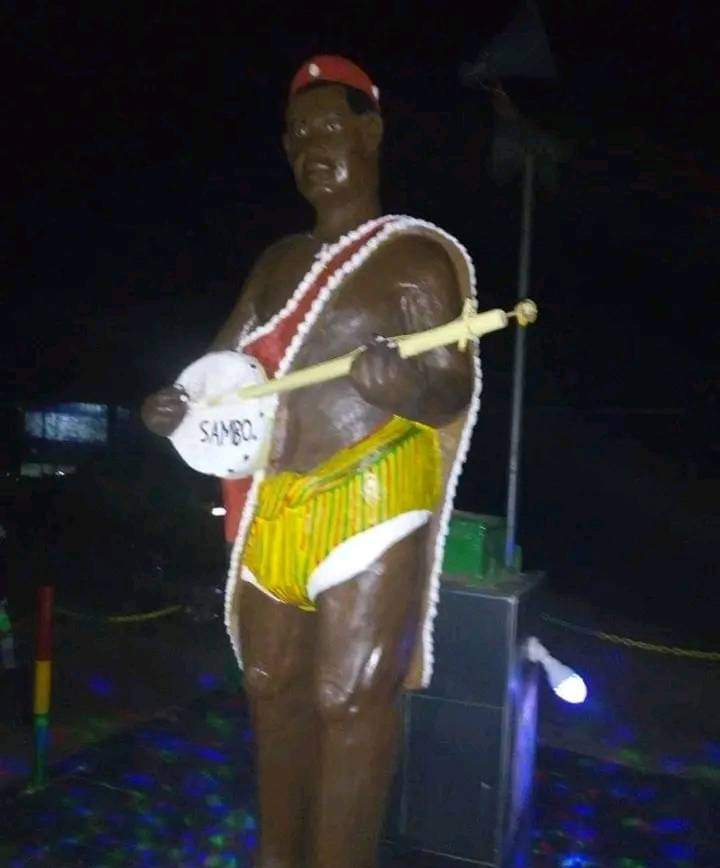
A few years ago, a statue was unveiled in front of the Bolga Craft Village in honour of Sambo Adabire. Sambo fan clubs are all over the upper east region and beyond. These fan clubs organise yearly celebrations to commemorate his legacy, the way reggae enthusiasts celebrate Bob Marley’s day. Due to the renewed interest in Sambo Adabire’s music, it is safe to say that his music will continue to live into the foreseeable future and generate interest and research among kologo music enthusiasts worldwide.
 My Bolga Online
He truly is a legend of our time, he’s unmatched. He teaches well with the string. Sambo will also reign in my heart as the true legend from the east part of the north.
Shout out to you Ras-Steve in your efforts to preserve culture.
LikeLike
Can’t forget as children how we used to sleep under huts deep into midnight just to see him play whenever he’s been invited to play during the festive season in my maternal village called Arigu near Pwalugu. He’s music songs encouraged some us not to give up in life no matter how tough things are and it has really helped shape and made us who we are due to the advisory lyrics and wisdom in his music. We have lost a great legend and he’s irreplaceable.
LikeLike