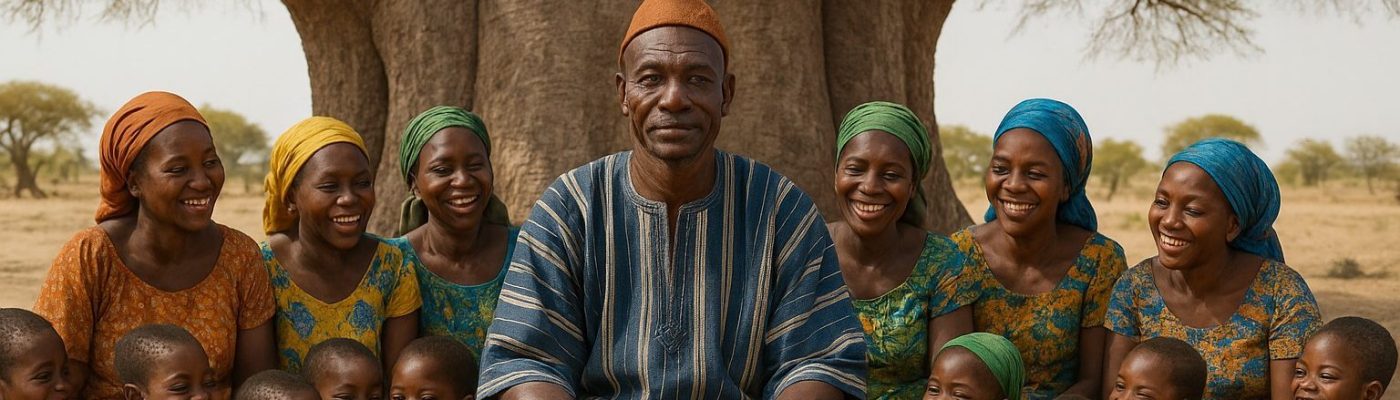
The concept of family in Frafra culture is a complex nest of relationships that go back to the past and outside one’s residence. The father was the head of the family. He had a double image: one at home and the other outside. In his home, he was the master, but outside, he became part of a community where he recognised that alone, he was vulnerable and made connections and friends with others. He had to hold a certain moral high ground to be recognised among the comity of men.
Depending on individuals, aspirations, and capacities, Frafra men dedicated a large part of their time in the rainy season to farming together with their colleagues on each other’s farms and individually. They prepared the land, weeded the farm, and turned the soil for good harvests. Frafra men generally worked in close-knit groups of friends and trusted people. These friends helped each other in communal labour. They could even sometimes come together to contribute money to each other. These groups were not antagonistic to other groups or those outside their groups; some belonged to other groups based on friendships. When they went hunting, they moved in groups. When they went for wrestling competitions, they went in groups. These groups could sometimes be comprised of people from the same extended family.
In the dry season, Frafra men hunted in the forest, moving in groups. The concept of hunting was a preparatory ground for young men to develop their hunting skills. The hunters gathered at a certain time of the year, and in groups, they went to the forest to hunt for animals. It was always a time of bonding with the young people who came out to join the hunting expedition. Through that, they learned the skills from the older hunters. They started by sharpening their knives and boiling the poisonous “yabiga” leaves. They boiled it until only the poison was left, into which they dipped the arrows and dried them. These arrows were handled carefully because even a scratch from the poisoned arrow could cause serious health implications for a human. Children were not allowed to witness this process or even know the plant. Indeed, only a few people knew of the “yabiga” plant and its appearance.
The man was responsible for catering for the family, providing the daily means of livelihood, and performing his duties to his wife, and if he had many wives, he could assign each a day to his room. A Frafra man can marry as many wives as he wants. A man with many children means a good source of farming labour, and since Frafras were predominantly farmers, more hands at the farm were important for maintaining any social status.
The women in a polygamous Frafra marriage had different rooms and kitchens, each woman to her kitchen, each woman to her room and children. The women could visit their husbands based on the arrangement decided upon. In a polygamous marriage, if the man missed or decided not to honour these arrangements, it could cause trouble in the family. Sometimes, a wife would go to her village and bring her sister to marry her husband. If rivalry brewed between wives, it could even spark a cycle where more wives were added as a form of alliance-building. This was noticeable especially among chiefs and rich people, where, if you did a little investigation, you would find that the wives were often related.
If the father were wise, he would teach his children to love one another regardless of which mother they came from. He kept them working together, away from their mothers’ influence. But when he died, if peace could not be maintained, each group often moved out with their mother.
When it comes to marrying many wives, it is a heated topic in the current generation, and the following rant is mine (Atibila). I think Frafra men should marry more wives. We must not abandon our culture for the sake of Christianity or modernity; we must own it and be proud of it. It is our tradition, custom, and a strong way to perpetuate our heritage. This should happen if the man can provide, and all parties consent. Our ancestors knew it. Today, we know that they are uncountable when you say Anongba bisi. When you say Abaa Bagre bisi, they are uncountable. When you say Anafo bisi, they are uncountable. When you say Amogre bisi, they are uncountable. Think about it. They had brothers and friends. Where are their descendants now? Think about the families in your village who have gone extinct. Think of those whose houses have become “dabooro”, or ruins. Being the lastborn of my mother, I wouldn’t have had lovely junior sisters if my father had not married my stepmother. Now, I hear some saying, “What about the economic aspect?” Well, more wives might just be what you need to make you search for wealth. As they say, the past is the path to the future. Only when we understand how things were before us can we fashion a proper way for the future. But this is my opinion, now, let’s continue with the father’s role in Frafra culture.
The father had a duty to his children, to bring them up as upright community citizens, correcting them when they were wrong and guiding them through the intricate labyrinth of oral history and responsibilities. He sent them to the cow field to learn survival skills and wrestle with their mates. This is perhaps why children who went through the ritual of serving as cowboys became strong and resourceful adults, able to withstand whatever pressure was mounted on them. It must also be said that this ritual was not the exclusive preserve of boys alone. When a family had no son to follow cows but had daughters, one of the daughters would be asked to take the cows out. These girls wrestled with the boys and went through the same rough terrain. When they grew, they became strong, resilient women. An elder once remarked, “If you don’t want disgrace, never fight a girl who once followed cows before.”
It was the father’s responsibility to train his children in the things that would make them independent. He took them to the forest to hunt with him when they came of age. He disciplined his children with the whip when they went wrong, and though the children usually got angry with their fathers, they learned it was for their good.
He was the spiritual head of the family. He went to the soothsayer to seek guidance from the ancestors and gods. If your father were alive, you wouldn’t have visited the soothsayer. As the father died and each sub-unit moved out, the young men led the family by visiting soothsayers to make sacrifices to the gods and ancestors to guide them in their daily activities.
The man in the family did not stand alone. He had an array of interrelated people. He might have had brothers and sisters staying with them or living elsewhere. He had relatives on his father’s side, including his brothers, half-brothers, and their children. His father also had brothers and their children. His father had an uncle’s house, and his maternal uncles also had roots there. His grandfather, grand uncles, grand aunties, and their families were all part of the extended household. The mirage of family interrelations within the Frafra culture was like a maze in which, once inside, it would be difficult to pull out. It went back that way on each side.
This happened when looking forward, too. His children also married into different families, both girls and boys. They also begot children, and the same cycle went on. Indeed, these traces are not unique to Frafra culture and are prevalent in all human societies. However, the importance of these connections within the Frafra culture is deep. All these family lines were considered part of the extended family, and the death of one in this lineage was attended by all the families that found a link to the family concerned.
One of the most significant implications of these interconnected family lines occurred during marriage. The couples were investigated to find out if they were related somehow through each of these arrangements and recognition of family. If a distant blood relationship were discovered, the family would decline to proceed with the marriage arrangement.
When a man dies in old age, his funeral is mostly in two phases. The first phase is the burial, which takes two days. The first night is like a wake-keeping, and at the very early hours of the night, they would “wua”, that is, officially announce the death, through the singing of “baanga” (dirges), and drumming while walking around the house three times.
The next day, towards evening, they bury him. If he left behind well-to-do children, they would kill a cow in a rite called “Kugle.” If the children are not well-to-do, they would kill a goat or a sheep. If he had daughters who had married, they would be called “deema,” each coming with her musical group. The celebration grows as more married daughters come. But other extended family members would fill the space if he had no daughters.
The second part of the funeral is the funeral proper. It can occur soon after the burial or be postponed to the next year or any time the family is ready. This funeral takes three days. The first day mirrors the wuure, except the burial is symbolic; it involves the man’s clothes instead of his body. The second day involves soothsaying to determine the cause of death. The third day is the kuure yu’a, the final closing. After the funeral, the man’s lands and property are divided among his sons, based on seniority. His eldest son also inherits the gods from his father. After many years, the son erects a monument (god) in his father’s name.
Our ancestors knew it. Today, we know that they are uncountable when you say Anongba bisi. When you say Abaa Bagre bisi, they are uncountable. When you say Anafo bisi, they are uncountable. When you say Amogre bisi, they are uncountable. Think about it. They had brothers and friends. Where are their descendants now? Think about the families in your village who have gone extinct. Think of those whose houses have become “dabooro”, or ruins.
In conclusion, the Frafra father was many things. He was a farmer, a hunter, a teacher, a husband, a moral guide, and a spiritual bridge to the ancestors. He stood at the centre of a web of people, brothers, wives, children, friends, cousins, and the dead who still speak through the soothsayer. His life was not his own. It belonged to the land, the family, the past, and the future. A man’s strength was measured not by how loud he spoke, but by how many lives stood behind him. Work was shared. Struggles were shared. Food, too, was shared. Children were shaped by the land, by fire, by cows, by stories, and by the firm hands of fathers. Marriage was not just love but lineage, labour, and legacy. A man could not know who he was unless he knew who he came from. If we forget the father’s role, we forget the roots that hold the house together, for even the biggest tree falls without roots. And so, we are left with one final question that each of us must answer quietly, in our own time. Are we living up to the expectations of our forefathers, or are we living up to the expectations of someone else’s ancestors?
Written by Atibila.
 My Bolga Online