Accra, Ghana. In a bold challenge to mainstream cosmology and religious doctrine, Ghanaian author and activist Dr. Stephen Atalebe released a groundbreaking new book, A Universe Without Beginning: A Cyclical Infinite Organic Universe. In it, he argues that the universe is not an inanimate expanse of space, but a living, breathing organism, and that everything within it, including us, functions like microbes inside a host.

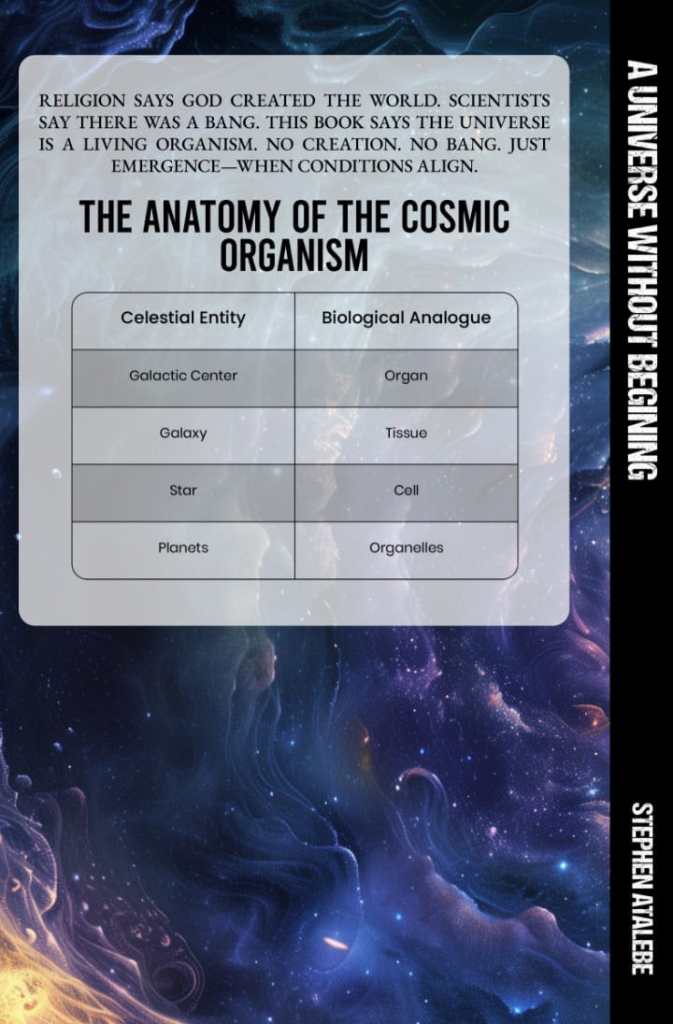
Departing from both the religious view that God created the universe and the scientific model of a singular Big Bang origin, Atalebe contends that life did not begin, but emerged, naturally and cyclically, when the right conditions aligned. “No creation. No bang. Just emergence,” he writes.
According to the book’s central thesis, stars are the cells of this universal organism, galaxies are tissues, and planetary systems are organelles. In this model, Earth is not an isolated rock but an active part of the cosmos’ living body. Humans and other life forms are quantum-scale participants, existing much like bacteria thrive within a living being, unknowingly supporting the health and function of the larger host.
Blending philosophy, cosmology, biology, and mathematical speculation, A Universe Without Beginning invites readers to rethink time, entropy, and the role of life itself in the cosmos. The book includes original mathematical functions that attempt to describe the universe’s self-regulating cycles of transformation, regeneration, and decay.
Far from a fringe theory, Atalebe’s ideas build upon the work of major scientists who have questioned linear cosmology, such as Roger Penrose and Paul Steinhardt, but push further by fully embracing the metaphor, and perhaps reality, of a living universe.
With its audacious claims and accessible style, A Universe Without Beginning is already sparking debate in philosophical and scientific circles. Whether seen as visionary or controversial, the book marks a major contribution to Africa’s growing presence in global cosmological thought. “This model doesn’t just ask where the universe came from,” Atalebe explains. “It asks what it is and what we are, within it.”
 My Bolga Online