
Written by Stephen Atalebe
Poka lived in a community called Kunkua. One day, Poka was walking when she heard voices, and when she looked around, there was no one. Before she could cry out in fear, they started talking to her. They told her they were the spirits of the dead from a faraway village. They warned her from talking to anyone about them. Since then, they come and go when she is alone. Poka Akinseelum was the last of five children of Baba Akinseelum’s family. It was early morning in the Akinseelum’s household. Poka had just woken and wiped her face when her mother called out.
“Poka!” her mother, Nma Anaya, called from her room.
“Nma?” Poka responded.
“We don’t have water. Take the big pot to the stream and get us water.”
“Nma, my neck,” Poka said. “Can I take the smaller pot?”
“Your neck?” her mother said, coming out of her room and trying to tie a cloth around her. She was tall with a round face and quick eyes, scanning everything within her radar. “When I was your age, I could carry pots bigger than this; you must take the bigger pot.”
Poka nodded to her mother, seeing that no amount of argument could persuade her mother to rescind her decision. She took the big empty pot and headed out of the house.
Outside, her father, Baba Akinseelum Bagna, drew smoke from his pipe and conversed earnestly with another man. Poka didn’t immediately recognise him.
It was the beginning of the rainy season, and her brothers were preparing the land for planting. To her right side was Anafo’s house, the house of Talata, Poka’s close friend. Baba Anafo has only one son, the only one on the farm; there was no sign of Talata. To her left was the Afai Ka’s house. He has two sets of twins: two boys and two girls. Afai Ka himself was on the farm. There was no sign of his children.
Poka sang softly, balancing the empty pot on her head and taking her steps carefully, the cold earth massaging her bare feet.
The yellowish sun marked the beginning of the day. Birds sang above the trees while crickets chipped eerily on the ground to welcome the new day. Goats bleated, and anxious hens clucked. A donkey hee-hawed from the distance while a bull bellowed nearby.
As she walked and sang, Poka heard the familiar heavy steps which announced the coming of the voices. The sound was faint at first but grew louder until she listened to their arrival with interest, which came with a thud.
“Alela and Atiama here to keep you company,” the voice said. “Poka Akinseelum. It is the morning of the day when everything starts.“
“Tell me, Alela,” Poka said. She looked around, ensuring no one was nearby to eavesdrop on her. “When you were young like me, did you carry a pot as heavy as this?”
“No, I never carried a pot. Everything I needed was provided for me. It was a mistake that my parents made.”
“Why?” Poka asked.
“I didn’t know how to carry a pot or cook food for my husband. He soon realised it and married a second wife,” Alela said.
“You think it’s good to carry water every day like a donkey?” Poka said.
“I don’t think anything,” Alela said, and Poka could detect some form of emotion on Alela’s part.
“What about you? Atiama? Did you carry water when you were alive?”
“Yes, I did, and I hated it, but it served me well. We have a message for you.”
“What message?” Poka said, looking around nervously.
“You must go to the chief and deliver the message only to his ears. Someone is bringing him a gift of pito. All his elders who drink that pito will die, including your father, who will be there.”
“My father, too?”
“They will assemble at the chief’s palace soon. Midday today, it happens. You can stop that from happening.”
“I have never been to the chief’s palace. I just can’t walk there alone like that,” Poka said.
“That’s what you have to do. Today is the day.”
“What’s it about today being the day?”
“You will soon see it.”
“What if I tell my father to warn the chief?”
“Your father will not believe you, and everyone will die like us. Only to the ears of the chief.”
“This is too much for me. Is there another way of doing it without me going there?”
When she stopped talking, she heard a sound and turned abruptly to see that it was her friend Talata who looked at her with her mouth and eyes wide open.
“Who were you talking to?” Talata said and emerged from her hiding place.
“No one,” Poka said.
“Don’t lie to me. I heard you. Is everything working well up there?” Talata said, pointing to her head. “Only mad people talk alone…”
“Stop it, Talata!” Poka shouted.
“Something is wrong with you. You need help,” Talata said.
“This is not how friends behave. You’re acting like my mother, and I don’t like it. You’re supposed to be my friend, not my critic.”
“Madness starts gradually until it gets out of hand. It’s better to snub it when it starts. I can’t let you go that way, and that’s because I’m a true friend,” Talata said.
Poka continued walking along the path while Talata followed behind, breathing down on her neck. She fetched the water at the stream, and Talata helped put the pot on her head. The weight of the water immediately pushed her neck down. She helped Talata put the lighter pot on her head, and they walked back without talking until they took their separate ways.
By the time Poka reached the house, she could barely walk but didn’t hesitate. Her mother rose and helped her bring the pot down.
It took Poka a while before she could feel better. She didn’t notice her father outside; he wasn’t inside either.
“Where is Baba?”
“He’s gone to the chief’s palace. Go and prepare zonko’om for your brothers.”
Poka nodded and went into the room. She had already grounded some flour yesterday. She took it, kept it in the calabash, and began preparing the flour water. It involves adding shea butter to the floor and mixing it until it is thoroughly mixed with the flour and then adding a little water to the flour while mixing it gradually until it becomes solid. A part of the solid flour is mended to the surface of the calabash. The other part is broken into crumbles. She placed the calabash on the floor, took another calabash filled with water, stood up holding the calabash with both hands, her fingers wrapped around the edges of the calabash so that her index fingers formed an opening through which the water flowed down into the calabash with the flour. The water hitting the flour creates bubbles on the surface of the final product. When she was done, she took the big calabash outside to her brothers. The senior most was Afii, followed by Afibila, Afibire, and Afipika. They stopped farming when they saw her coming with the water.
“Thank you, sister,” Afii said. He took the calabash from Poka. She returned and brought them wooden spoons to eat the flour.
“Now, go and look for firewood; we don’t have any firewood to cook,” her mother said.
Poka nodded. She took a stunted cutlass and came out of the house. Noon will soon be upon the land. Her father and everyone will be there, and they will drink the pito and die. She couldn’t stand while this happened, even though she dreaded going to the chief’s palace. Poka dropped the stunted cutlass outside the house and started walking toward the general direction of the chief’s palace. She must warn them, but only to the ears of the chief. She didn’t know how she would be able to do that. The impossibility became more apparent when she saw a lot of elders loitering around the chief’s palace. She approached carefully, looking down on the ground, avoiding looking straight up. She was afraid she might run back if she saw so many elderly people. She didn’t know how her father would react.
The closer she got, the more nervous Poka felt. There were no children anywhere near here. She looked around carefully. The chief didn’t seem to be present. She took a deep breath.
“Hey Poka, what are you doing?” her father’s voice stalled her. She turned immediately and ran to the gates of the palace.
“Poka!” her father’s voice didn’t stop her. Immediately she entered the house, she was greeted by a big woman who was going to throw rubbish outside.
“Who are you looking for?” the woman said.
“I’m looking for the chief?” Poka said.
“He’s about to go for a meeting,” the woman said.
“I must speak with him now!”
The woman considered Poka.
“Poka!” her father came into the house. The woman looked up.
“Is that your daughter Baba Akinseelum?” the woman said.
“Yes, I don’t know what she is doing here?”
“She wants to speak with the chief.”
“About what?”
“Only for the ears of the chief, right now!” Poka said.
“What is wrong with you, Poka? Thank you Nma Agonpoka. I will take her home now.”
Poka looked at the woman with begging eyes and a resolute conviction.
“No! I must tell the chief something right now,” Poka said.
“Something is wrong with my daughter; she’s never been like this before,” Baba Akinseelum said, grabbing Poka’s hand and pulling her.
“Stop!” Nma Agonpoka said. “I’ll take her to the chief.”
“She doesn’t have anything to tell the chief. The meeting is about to start, and the chief will have no time for her,” Poka’s father said.
“I’ll make him have time for her! Come, let’s go. Now, Baba Akinseelum, join your colleagues as though nothing happened.”
Nma Agonpoka held Poka’s hand and took her through a maze of walls and dwelling subunits until they came to a big round room in the middle of the house. A number of the princes were lined up outside the chief’s room, waiting to lead him outside.
“My dear husband. There’s someone here who has a message only for your ears.”
There was a light cough from inside, and then the almost guttural voice of the chief drummed from inside.
“What do I have to hide from my princes? Say whatever you have to say.”
Poka looked around at the princes and shook her head.
“I need to deliver this message only to your ears,” Poka said.
“Oh, it’s a daughter. Come inside.”
Poka walked into the chief’s hut. From the outside, it looked dark, but once inside, it brightened a little. She saw the chief. His face was covered in grey hair, but he looked firm and studied Poka carefully. Poka went closer to his eyes and whispered to him.
“Someone is bringing you a gift of pito; it is poisoned.”
The chief withdrew from her and looked at her, first with anger, concern and a dawning realisation sweeping through his face.
“How do you know this?” he asked.
“If you don’t believe me, let the owner of the pito taste it first and watch him, that’s all. I’m done.”
Poka turned and walked out of the hut. The princes looked at her curiously. Mma Agonpoka looked at her and smiled.
“My dear husband. Can I let our daughter go?”
There was a clearing of a throat and then some movements. The chief came outside.
“She’s Baba Akinseelum’s daughter,” Mma Agonpoka said.
The chief knelt before her in the presence of the princes, who looked around nervously.
“Thank you, my daughter. Go in peace.”
Poka looked at the chief. His general demeanour seems to reflect a good man, which was satisfying. She nodded, and the chief stood up.
Mma Agonpoka shook her head, “What did she tell you?”
“I will know soon. Help her out of the house,” the chief said.
Poka came out of the palace and headed home. She did not turn or look back to see if her father saw her leave. The stunted cutlass was still lying where it was when she left it. She went to take the remains of the empty calabash and wooden spoons. She took them inside. Her mother looked at her in shock.
“Are you still here? I thought you had gone already?”
“I’m going now.”
She took a basket, came out, picked up the stunted cutlass outside, and made her way to the forest to cut firewood. A tiny forest marked the village’s borders from the neighbouring town. It was more like a sanctuary for her to be away from the house. It was the season for early shea nuts, especially the delicious ones. If she goes there alone, the voices always come, and sometimes there are even many. Poka didn’t know why they chose her. Under normal circumstances, she would have invited Talata to come along, but it wasn’t the best thing to do after what happened earlier in the day. Across the fields, a few cowboys manned the animals. One of them was playing a flute, and it filled the empty sky with a sweet melody.
She climbed the shea nut tree and shook the branches. The twigs and ripe fruits fell to the ground. She went from one branch to the other and then searched for dried twigs still hanging loose from the branches. Working from one branch to the other, she shook the branches until nothing could be shaken down. She finally came down. She inspected her work, gathered the twigs, bundled them, and then picked and gathered the fruits. She ate some shea fruits, savouring the delicious fleshy fruits and throwing the nuts away. While she was eating the shea fruits, the familiar footsteps started to come.
“Poka, you did well today.”
“I don’t want to do this again.”
“Even we have no understanding of some of these things. Only a few living beings are chosen along this path.”
“What path? I haven’t chosen any path.”
“You’re the spirit child. The one who can hear and speak with the dead. Only you in all of the lands around this part of the world have been chosen. This is your path in life.”
“I don’t want people to think I’m a mad woman.”
“Not everyone who dies remains as a spirit. They come back into the world when a woman conceives. I’m forbidden from returning to the world and must remain forever as a spirit. It wasn’t our choosing, but come to think of it, we see a lot that others don’t know.”
“Why are you forbidden from returning to the land of the living?” Poka said.
“We did things when we were once humans that we can’t go back. Every time you try, you die at infancy, never allowed to grow until you give up trying and come to accept the painful truth that you can never go back.”
“What did you do, Alela?”
“I killed my husband and his second wife out of jealousy and then committed suicide.”
“What about Vola?”
“You must ask him when he comes.”
“How long ago have you been dead?”
“A long time ago. My great-grandchildren are very old now. I used to visit them when my children were alive. After the incident, they endured many hardships, and everyone left the house.”
“Is it because you committed suicide that you’re not allowed to return to the living?”
“I don’t know.”
“What about me? Did you know my spirit before I was born?”
“Yes, you commanded us to keep watch over you and lead you to the mountaintop.”
Poka shook her head.
“What are you talking about Alela? What mountaintop?”
“You didn’t expect to come out as a girl, but it will still do. We go there the day after today.”
“I don’t understand.”
“You’ll never understand.”
Poka gathered the shea fruits into the basket and went around, picking the twigs together and tying them into a big bundle.
“What I don’t understand, you must make me understand.”
“You have to learn everything by doing it. You should first learn how to do things yourself and be a normal child before your abnormality manifests.”
“I’m a normal girl.”
“Yes, you’re a normal girl imbued with supernatural powers. The earlier you accept your fate, the better you make good use of it.”
“What good could come out of it?”
“Whatever good you wish to come to you or someone closer to you shall come to pass. What evil you wish on someone shall come to pass. That’s who you are, Poka, but you must bear the tooth and save your people from imminent death.”
“I don’t wish evil to come upon anyone. I want everyone to be happy and doing what they are supposed to be doing.”
“That’s good to know.”
When she finished putting everything together, she struggled to put the load on her head and had to use the tree trunk to assist her. After trying and failing three times, she got the bundle of twigs onto her head on the fourth try.
“These are the things I or any of us can’t help. We can’t touch materials or eat food, but we can smell the scent of alcohol.”
“I don’t need your help to carry the firewood. How much of the future do you know?”
“We don’t know the future, but we can hear the evil plots of men which inevitably lead to the future. Good people hardly start any change; the evil deeds of bad people make good people act.”
“I just want to be a normal girl. I don’t want to be involved in anything.”
“I hope that was possible, but that can’t happen. Avola and the other spirits are at the chief’s palace, eavesdropping on what the living are doing now. From today, you’ll no longer be a normal girl.”
“Why?”
“All those elders, including your father, will own their lives to you. Be prepared for what is to come.”
“It was you who told me. I didn’t know about it on my own accord. It’s not my making; it’s your doing.”
“Unfortunately, that’s not what they will think.”
The appearance of cowboys leading the animals into the forest interrupted their conversation, and Poka carried the wood and fruits home. Her brothers were still on the farm when she returned, but only the senior one was on the farm. The rest were resting under the shade of the dawadawa tree. She hurried to the house and dropped the load off. Talata sat and talked with her mother, who looked up when Poka entered the yard.
“Have you been talking to yourself?” Nma Anaya said.
Poka was looking at Talata with disdain in her eyes. She closed her fist and then suddenly held herself. The voices have informed her that if she wish evil on someone, it shall come to pass, but she didn’t want anything wrong to go to Talata. Poka turned and headed into the kitchen, took the broom and started to sweep.
“Did you hear my question?” her mother said. “Do you talk alone to yourself?”
“No, I don’t have any answer for you,” Poka said.
“What does that mean? Don’t you know if you’ve been talking to yourself?”
“I don’t know.”
She swept the kitchen clean and carried the rubbish outside. She saw her father coming home from the chief’s palace. He walked slowly but surely. The years have sapped the energy from her old man; his laboured steps and the absence of strength in his dangling hands are all evidence of the ravages of age.
She went back into the house. Talata was standing up, ready to leave. She wasn’t probably satisfied with the reaction that she was seeing. But Poka understood that whatever Talata was doing, it wasn’t out of malice. Talata stood, fidgeted for some time and left.
There was a throat clearing, and Baba Akinseelum came into the yard shaking his head.
“My husband, what is going on?” her mother said.
“Ask her,” he said, pointing to Poka. “She knows better than I do.”
Her mother turned her attention to Poka now, curiously looking at her.
“What did you do, Poka?”
“She saved us; yes, my daughter saved the village elders today.”
“What happened?”
“This morning, I was called that the chief needs our presence because Sapark was coming to thank the chief for his decision, which wasn’t in favour of Sapark. I was there when I saw Poka running to the chief’s palace, saying she had a message for only the chief. She didn’t tell me what, only told the chief. When Sapark presented his drinks to the elders, we all poured out the pito into calabashes and waited for the chief’s final blessing before we could drink. The chief asked Sapark to drink the pito first. The dread on Sapark’s face gripped everyone. He looked around nervously and then decided to drink the pito. One other elder who couldn’t wait also drank the pito. It was swift. Sapark began to shake, and right before our eyes, foam started forming in his mouth, and he fell. The other elder who drank the pito also went down. I held the pito in my hands, looking at it and wondering how close I was. We poured it away and attended to the dead. How did the chief know? He wouldn’t tell anyone. He was as shocked as everyone. However, I know how he got to know it. This brings me to you, Poka. How did you know?”
“She has been talking to herself lately!” Nma Anaya said. “Her friend caught her.”
“My daughter is behaving like a stranger to me. You could have warned me, what if I had drunk that pito?” Baba Akinseelum said.
Poka looked down at her palms, avoiding her father’s eyes.
“Maybe if she told you, you wouldn’t have believed her,” Nma Anaya said.
Baba Akinseelum was silent for some time, shook his head and looked at his daughter as though she was a total stranger to him.
“I knew you wouldn’t be the first to drink,” Poka said.
“How did you know the pito was poisoned?” her father asked.
“I don’t know how. I had to deliver the message to the chief.”
“Deliver a message from who?”
“I had a dream.”
“When did you have that dream?”
“It doesn’t matter.”
“Well, if you had the dream when you woke up, you would have gone to the chief’s palace early in the day.”
“Because I had to fetch water.”
“It really doesn’t matter. You saved me. Thank you for saving everyone today,” Baba Akinseelum said.
“Her friend found her talking to herself at the river today,” Nma Anaya repeated. “I don’t know what you’re talking about,” Poka said, went into the kitchen, and began to make fire.
She heard them speak outside and knew they were talking about her. She blew into the burning flames and ignited them. She kept a pot on the fire and poured water into it. She was going to boil millet for her brothers. It was one of the foods her brothers liked, after rice. She added dawadawa, tomatoes, pepper, salt and shea butter into the boiling pot and watched the millet boil in a frenzy.
She served the boiled millet into bowls and carried the bowls out, one after the other, first to her father, who continued to look at her strangely. She returned to the kitchen and served her mother, who was busily weaving a basket. She carried out the rest of the bowls to the dawadawa tree where her brothers were now resting. The sun was scorching, and the ground equally hot. Her bare feet hurt every step she took.
Her mother was still weaving. She hasn’t touched the food.
“Come and sit down, Poka. Eat something; you’ve worked so hard; take a rest.”
Poka took her portion of the food and sat by her mother.
“Tell me what happened to you? I can’t see, which means that my daughter shouldn’t be able to see, but if the things I’m hearing are anything to go by, then it means you see.”
“Nma, I’m not a witch!”
“I didn’t say you were. How did you know the pito was poisoned?”
“In a dream, Nma.”
“You can share with me; all I want to do is help you.”
“Nothing is wrong with me. I’m just a normal girl.”
“Talata told me that you don’t have an interest in boys; you hardly talk about boys in your life.”
“Nma!” Poka said, looking at her mother. “I’m just thirteen years old, and you’ve always told me to stay away from boys, and now you’re asking me about boys in my life?”
“When I was your age, my mum told me the same thing, but I couldn’t stop thinking about your father.”
“Nma, I’m different.”
“Exactly. What makes you different from other girls of your age?”
“I don’t know.”
“You must know something. Are there spirits talking to you?”
Poka looked up sharply at her mother, who also looked up at the sudden change in her daughter.
“I see,” she said and continued to weave her basket.
“I don’t know.”
Her mother remained silent and didn’t say anything anymore. The basket was almost done; she was now weaving the edges with a single brown straw.
There was noise coming from outside, which ended their conversation. Poka went out of the room and crossed the yard out. The noise grew closer. A group of people came towards their house with an umbrella hoisted in the air. Her father wasn’t there. It was the chief of the village and his elders. Poka went back into the house.
“Where’s the noise coming from?”
“The chief is coming?”
“The chief is coming to our house?”
“I think so.”
“The chief never visits anyone; he invites people to come to him, so if he’s coming here, it must be important.”
Poka didn’t say anything. She didn’t know if it had anything to do with what she had done in the morning and what the chief would say or do.
“I think they have arrived,” Poka said.
It wasn’t long before a messenger was sent into the house to call Poka out.
“Go, my daughter.”
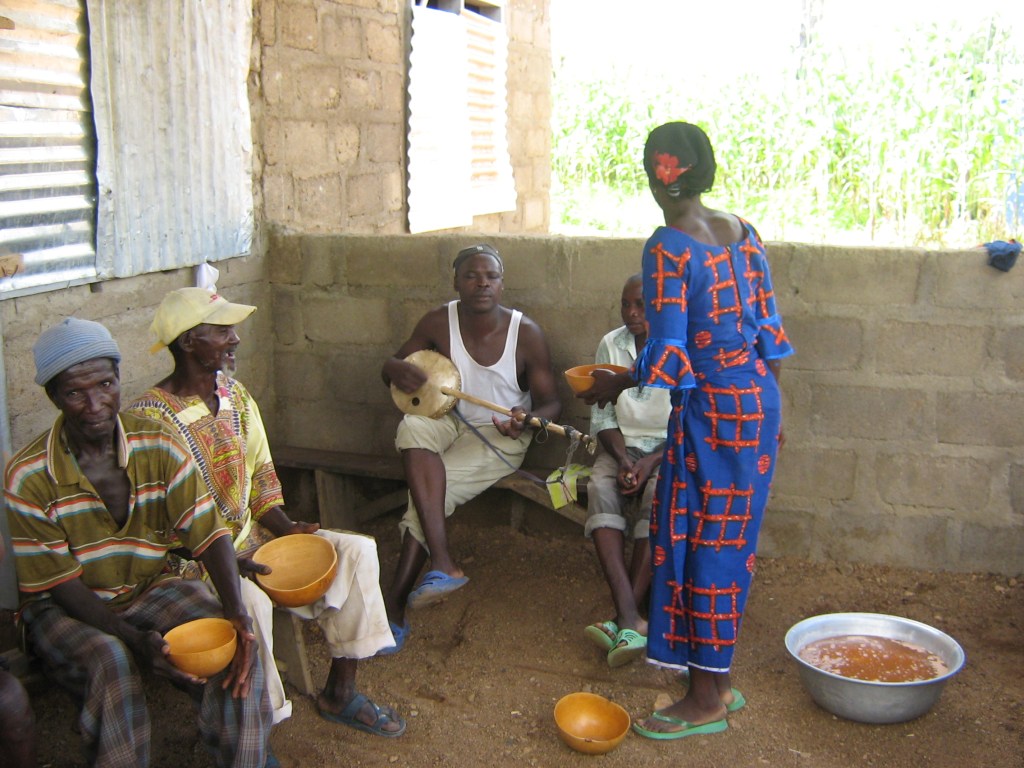
Poka came outside to a small crowd. Her brothers had left the farming and were standing behind their father, who had appeared out of nowhere. The chief looked up with a smile when Poka came out.
“Thank you, Poka, for saving all our lives today. We came to thank you and to tell you how grateful we are; we owe our lives to you,” the chief said.
Poka nodded.
“I was so close to drinking that pito. If not for the intervention of the chief, all of us would have been dead,” Baba Atunda said. Since she started to recognise people in the village, Baba Atunda has always been the same: grey-bearded, tall and lanky, bending towards the front all the time, and he walked with the support of a stick. “How you got to know, only the gods know. Sapark’s collaborators have come out to confess. Only three people knew of it, so even they don’t know how you could have known about it.”
“I saw it in a dream,” Poka said.
The chief nodded. “What else did you see in your dreams?”
Poka looked at the chief hard and close, closed her eyes and opened them, shook her head twice and said. “I see war coming. Prepare everyone, young or old, for war, a war we have no way of defeating, a war that sheds no blood but one that carries away. That’s all.”
(Note to the reader: If you like the tale and wants it to continue, show by your comments.)
 My Bolga Online